
DPMO Meaning in Text – Complete, Simple, and Practical Guide
DPMO Meaning in Text means Defects Per Million Opportunities. It shows how many mistakes happen in a process out of one million chances. This term is used in business, manufacturing, and professional work to measure quality and improve results.
Many people see DPMO Meaning in Text in reports or emails and feel confused. Learning it is easy. Knowing it can make you sound smart at work. It helps you understand quality and process improvements clearly.
DPMO Meaning in Text is important for companies. It helps track errors, reduce mistakes, and improve work. Teams use it to make processes better and satisfy customers. It is a simple number that shows big results.
What Does DPMO Mean in Text?
When you see DPMO meaning in text, it usually refers to Defects Per Million Opportunities. This term is used to measure the number of defects or errors that occur in a process out of one million chances. It is especially relevant in businesses and industries where precision matters, such as manufacturing, healthcare, software, and banking.
In professional settings, Professional text DPMO is often mentioned in emails, reports, or chat messages among teams focused on business process improvement. For example, a manager may say, “Our DPMO improved from 5,000 to 500 this quarter,” meaning the process is now much more accurate, with fewer errors per million opportunities.
DPMO in text is not slang. It is a technical measure that helps organizations monitor and improve process efficiency and operational excellence.
DPMO Full Form and Simple Definition
The DPMO full form is straightforward: Defects Per Million Opportunities. Breaking it down: Defects are errors or mistakes, Per means for each, Million refers to one million, and Opportunities are the chances for a defect to occur.
In simple terms, DPMO tells you how often mistakes happen when a task or process is repeated many times. This is very useful for companies trying to achieve total quality management and reduce errors systematically. For instance, in a production line making 10,000 items, if 50 errors occur and there are 5 opportunities for errors per item, the DPMO calculation helps quantify process performance accurately.
Understanding the DPMO full form is essential because it forms the backbone of Quality control measures and guides teams in defect reduction strategies.
Why Is DPMO Used Instead of Simple Percentages?
You might wonder why businesses don’t just report “5% errors” instead of using DPMO. The reason is precision. Percentages can sometimes hide small but critical issues. DPMO in Six Sigma provides a more accurate picture, especially for complex processes with multiple opportunities for defects.
Using DPMO allows organizations to make fair comparisons across processes, teams, or even different industries. It aligns with Lean Six Sigma methodology and supports the goal of achieving world-class quality standards. For example, two production lines may each have a 1% defect rate, but if one line has significantly more opportunities for errors, DPMO will reveal which line truly performs better.
This is why quality measurement DPMO is preferred in professional reports and strategic discussions. It is precise, measurable, and directly tied to customer satisfaction metrics and operational improvement.
DPMO Meaning in Text Messages vs Business Context
In casual texting, DPMO meaning in text is almost never used. It is strictly professional and appears in environments where monitoring process defects is essential. In the business world, Professional text DPMO is common in quality reports, emails between managers, manufacturing discussions, or project updates in process improvement metrics.
For example, a project manager might write in a report, “High DPMO indicates training gaps among staff,” highlighting how error rates affect process efficiency and overall operational excellence. The use of DPMO in professional text ensures clarity, accountability, and a shared understanding of process quality among team members.
Where Is DPMO Commonly Used?
DPMO in Six Sigma and business practices is widely used across various industries in the USA. Manufacturing uses it to measure manufacturing defects and improve production lines. Healthcare systems track medication or procedural errors to ensure quality assurance. Software development teams monitor bug occurrence to enhance process efficiency.
Even service industries, such as banking, finance, and call centers, use DPMO as a performance measurement KPI to track customer satisfaction and reduce errors. In each case, the goal is the same: use DPMO calculation to understand where process variation occurs and implement defect reduction strategies.
DPMO and Six Sigma Explained Simply
Six Sigma is a method focused on reducing errors and improving process efficiency. DPMO in Six Sigma is crucial because it quantifies the number of defects per million opportunities. A simple table helps illustrate this relationship:
| Sigma Level | DPMO Value | Quality Level |
| 1 Sigma | 691,000 | Very Poor |
| 2 Sigma | 308,000 | Poor |
| 3 Sigma | 66,800 | Average |
| 4 Sigma | 6,210 | Good |
| 5 Sigma | 233 | Very Good |
| 6 Sigma | 3.4 | World-Class 🌟 |
The table shows that lower DPMO values indicate higher quality. Six Sigma projects use this metric to track improvement, reduce process defects, and achieve operational excellence. Companies aiming for total quality management heavily rely on DPMO in Six Sigma as a benchmark for error rate per million opportunities.
How to Calculate DPMO (Step-by-Step)
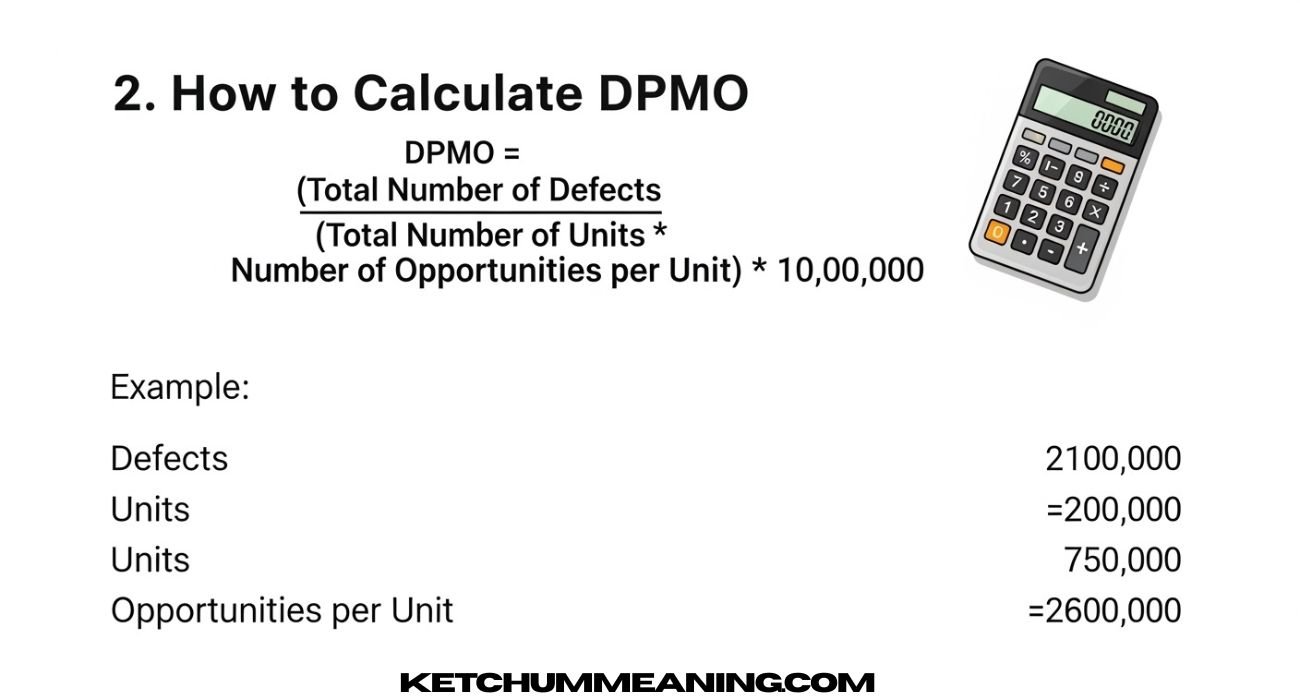
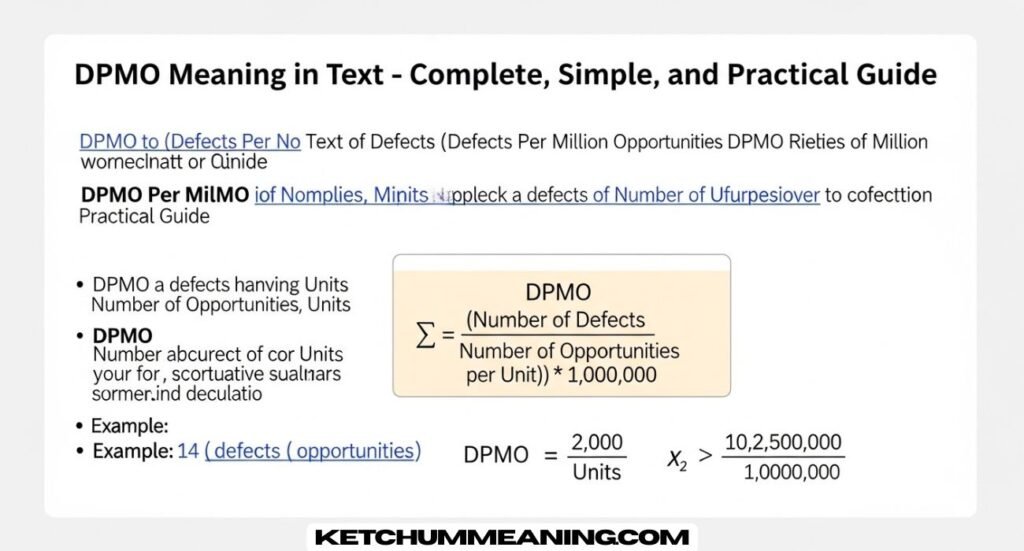
The DPMO calculation is simple but powerful. The formula is:
DPMO = (Number of Defects ÷ Number of Opportunities) × 1,000,000
For example, if a factory produces 1,000 units and each unit has 5 possible error points, there are 5,000 opportunities for defects. If 10 defects occur, the calculation would be:
(10 ÷ 5,000) × 1,000,000 = 2,000 DPMO
This means 2,000 defects occur per million opportunities. Using this metric allows teams to monitor quality measurement DPMO, compare performance over time, and implement business process improvement strategies effectively.
DPMO Meaning in Text with Real-Life Examples
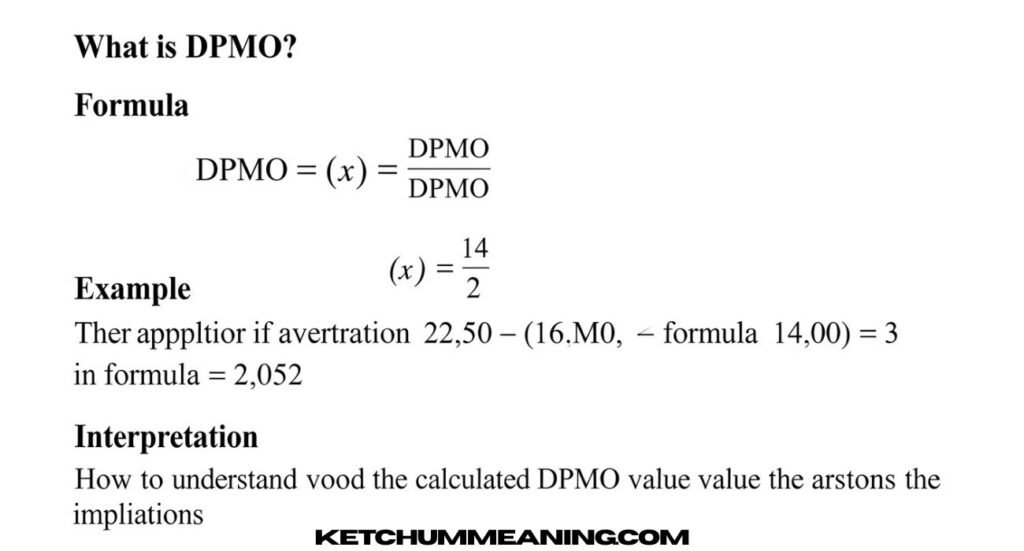
Here are some practical DPMO examples in text to illustrate its use. In a manufacturing company, a report might state: “After automation, our DPMO dropped by 70%,” showing improved process efficiency. In customer service, a manager could note: “Client complaints reduced because DPMO improved,” linking performance to customer satisfaction metrics. Another example might be, “High DPMO indicates process inefficiency,” highlighting the need for defect reduction strategies.
These examples show how Professional text DPMO is a reliable measure of process defects and helps maintain quality control measures across teams.
Is Low DPMO Always Good?
Generally, a lower DPMO is better because it indicates fewer defects, higher consistency, and improved operational excellence. Low DPMO directly impacts customer satisfaction metrics, ensuring better products and services.
However, chasing extremely low DPMO without considering cost may not be practical. For example, reaching a DPMO of 3.4 may require enormous resources in certain industries. Balancing process improvement metrics with cost efficiency is crucial.
DPMO vs Defect Rate: Key Differences
Many people confuse DPMO with defect rate, but they are different. DPMO measures defects per million opportunities, providing higher accuracy, whereas defect rate is a percentage and works best for simple systems.
| Feature | DPMO | Defect Rate |
| Measurement | Per million opportunities | Percentage |
| Accuracy | Very high | Moderate |
| Usage | Professional & Six Sigma | General |
| Best for | Complex processes | Simple systems |
DPMO vs defect rate highlights why DPMO in Six Sigma projects is preferred for complex processes and high-stakes operations.
How DPMO Helps Decision-Making
DPMO meaning in text is more than just a number; it is a tool for business process improvement and strategic decision-making. Leaders use it to identify weak areas, track improvements over time, and set realistic quality goals. It allows fair comparison between teams and ensures consistent quality assurance.
By monitoring process variation through DPMO, companies can implement effective defect reduction strategies, improve process efficiency, and achieve operational excellence. It transforms raw data into actionable insights, helping organizations reach total quality management goals.
Common Misunderstandings About DPMO
A few common misconceptions about DPMO can create confusion. First, DPMO is not casual texting language or slang. It also does not mean “delay per minute output.” Instead, DPMO full form always relates to process defects and error tracking. Understanding these distinctions prevents miscommunication in professional text and strengthens credibility in quality discussions.
When Should You Use DPMO in Text?
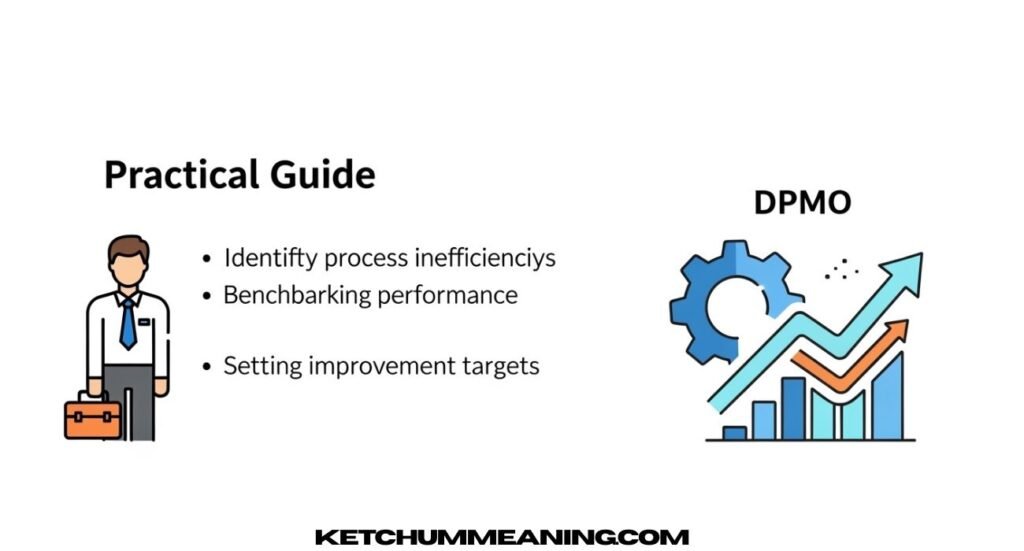
You should use DPMO meaning in text primarily in professional or business contexts. It is ideal for reporting quality measurement DPMO, discussing process improvement metrics, comparing team or system performance, and setting improvement targets. Avoid using it in casual chats unless everyone understands the term.
Custom Example Sentences Using DPMO
Using DPMO in Six Sigma or professional communication naturally requires practice. Some examples include: “We reduced DPMO by redesigning the workflow,” “Management expects DPMO below industry average,” “High DPMO revealed training gaps,” and “Our Six Sigma project focused on lowering DPMO.” These sentences convey expertise in process efficiency, quality control measures, and performance measurement KPI.
See Also : DWBI Meaning in Text: What It Really Stands
Related Topics You May Want to Explore
For a deeper understanding, explore topics like Six Sigma basics, quality management systems, Lean Six Sigma methodology, process improvement methods, and customer satisfaction metrics.
These subjects are closely linked with DPMO meaning in text and help you understand how to apply total quality management principles in real-world settings.
Understanding the Basics of DPMO Meaning in Text
DPMO meaning in text stands for Defects Per Million Opportunities, a key metric in quality management. It measures how often defects occur in a process and helps professionals track process efficiency. This concept is widely used in manufacturing, healthcare, and software industries for accurate performance monitoring.
Learning the basics of DPMO empowers teams to improve workflows, reduce errors, and ensure customer satisfaction metrics are met. By understanding DPMO in Six Sigma or professional reports, employees can make informed decisions that enhance operational excellence and maintain high standards in business processes.
Why Professionals Prefer DPMO Over Percentages
Using percentages alone can hide small but critical errors, making DPMO full form more precise for complex processes. Companies rely on quality measurement DPMO to compare different systems and identify areas that require defect reduction strategies. It aligns with Lean Six Sigma methodology principles.
DPMO provides a clearer picture than simple percentages by accounting for every opportunity for error. In professional text, mentioning DPMO calculation shows accurate tracking of process defects and allows organizations to plan business process improvement more effectively, ensuring consistent results and high-quality standards.
Calculating DPMO: Step-by-Step Guide
The DPMO calculation is simple yet powerful. Divide the number of defects by total opportunities and multiply by one million. For example, if 10 defects occur in 5,000 opportunities, the DPMO is 2,000. This metric helps monitor process efficiency and supports total quality management goals in any business.
Calculating DPMO regularly allows teams to identify process variation and improve workflows. Companies use these results to design defect reduction strategies and enhance quality control measures, ensuring that customer satisfaction metrics remain high and performance across departments meets professional standards.
DPMO in Six Sigma Projects
In Six Sigma quality metric projects, DPMO is crucial for measuring errors per million opportunities. Lower DPMO indicates better quality and higher process control. Teams use it to track improvements, implement process improvement metrics, and achieve operational excellence in production or service delivery.
By analyzing DPMO trends, organizations can make data-driven decisions and enhance efficiency. The metric supports total quality management initiatives and helps teams reduce process defects, improve performance measurement KPI, and maintain superior results across all business operations.
Industries That Rely on DPMO
Manufacturing, healthcare, software development, banking, and call centers often use Professional text DPMO to measure errors and improve outcomes. It allows managers to track process variation and maintain quality assurance standards while implementing defect reduction strategies across multiple teams or departments.
Even service industries use DPMO for business process improvement, ensuring higher customer satisfaction metrics. By monitoring error rate per million, companies can identify weak areas, improve workflows, and align operations with Lean Six Sigma methodology for better efficiency and professional reporting.
See Also : TB Meaning in Text: What It Really Means Today (2026)
DPMO vs Defect Rate: Key Differences
While defect rate measures errors as a percentage, DPMO quantifies defects per million opportunities. This makes DPMO full form a more accurate tool for complex processes. Organizations use it to track process defects, identify trends, and implement process improvement metrics that support professional decision-making.
Understanding DPMO vs defect rate ensures managers select the right metric for their operations. DPMO provides higher precision, allows fair comparison, and aligns with Six Sigma quality metric goals. Using it helps reduce errors, improve quality measurement DPMO, and maintain consistent operational excellence.
Real-Life Examples of DPMO in Professional Text
Companies often report DPMO in emails or project updates, such as “Automation reduced our DPMO by 70%.” This shows process efficiency and highlights improvements in quality control measures. Such reports help teams understand process variation and guide strategic business process improvement.
Other examples include tracking customer complaints, monitoring production lines, or evaluating service quality. By using DPMO in Six Sigma, professionals can communicate results clearly, reduce process defects, and ensure total quality management goals are achieved while maintaining high customer satisfaction metrics.
See Also : HMB Meaning in Text – Complete Guide for Modern Chats
The Role of DPMO in Decision-Making
DPMO is not just a number; it is a critical tool for decision-making in professional environments. Monitoring process defects and calculating DPMO in Six Sigma enables leaders to improve workflows, identify problem areas, and track progress in process improvement metrics efficiently.
Using DPMO helps managers implement defect reduction strategies, enhance operational excellence, and maintain consistent quality assurance. By integrating DPMO insights into reports and dashboards, organizations can ensure better performance measurement KPI and achieve long-term total quality management across all departments.
FAQs
What does DPMO mean in a text?
In text, DPMO refers to Defects Per Million Opportunities, a quality metric used in professional or business contexts.
What does DPMO stand for?
DPMO stands for Defects Per Million Opportunities, measuring errors per one million chances in a process.
What slang is DPMO?
DPMO is not slang; it is a professional term used in quality management and Six Sigma.
What does dmpo mean in a text?
In text, dmpo means Defects Per Million Opportunities, indicating the number of defects in a process.
Conclusion
Understanding DPMO Meaning in Text helps people see how many mistakes happen in a process. It shows errors for every one million chances. Using this knowledge makes work better and faster. Companies and teams use it to check quality, reduce mistakes, and improve processes. Knowing DPMO helps everyone follow rules and do tasks more carefully.
DPMO Meaning in Text also helps leaders and workers make smart choices. It shows where problems happen and how to fix them. People can track progress and measure results clearly. Learning DPMO helps improve work quality, save time, and keep customers happy. It is an important tool for every business and team.